
Current Event
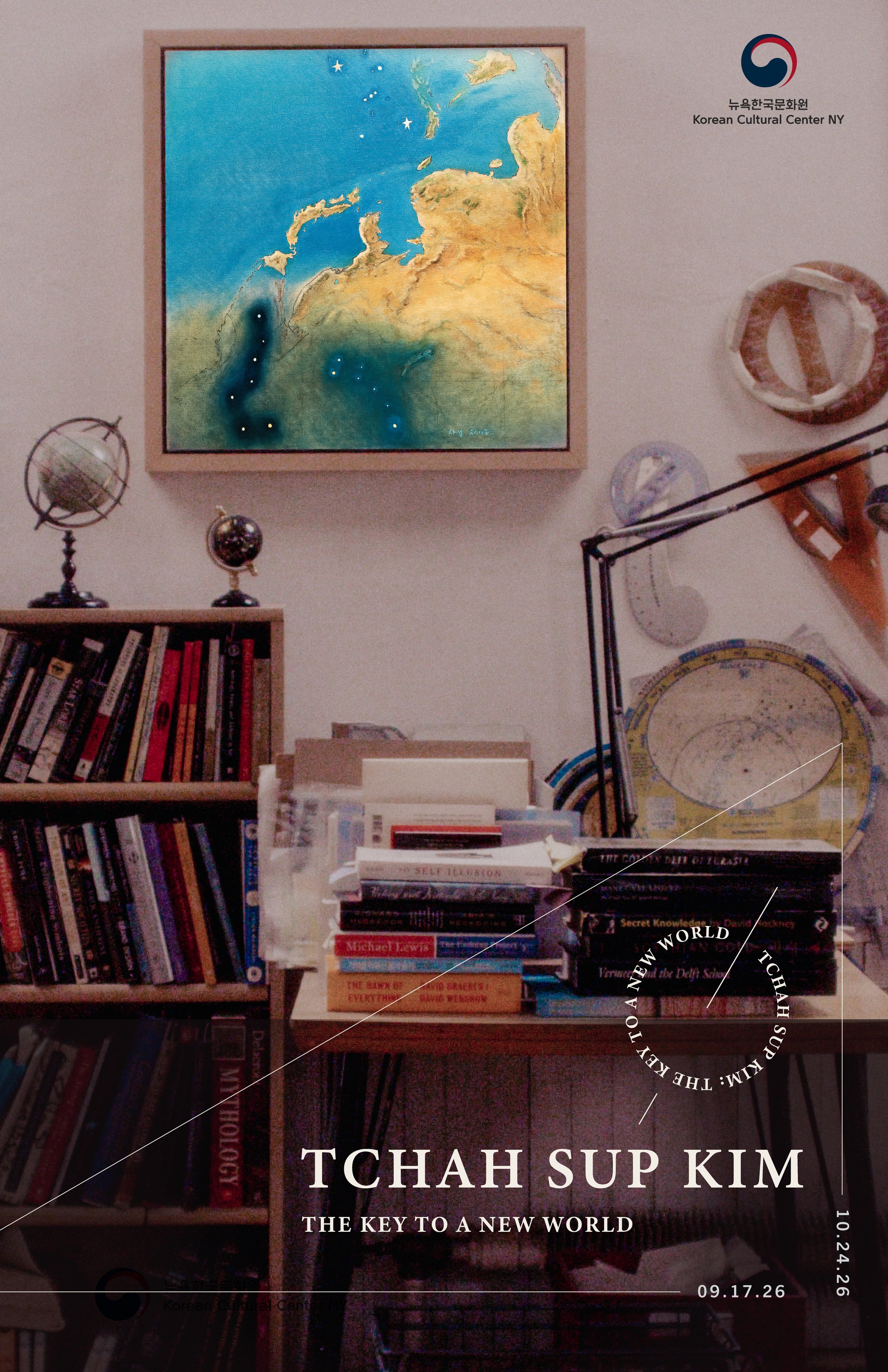
Tchah Sup Kim: The Key to a New World
On view: September 17 - October 24, 2026
Tuesday - Friday: 10 AM - 6 PM / Saturday: 11 AM - 5 PM
Closed on Sunday and Monday.
Venue: Atrium & Gallery at the KCCNY
122 East 32nd Street, New York, NY, 10016
Tchah Sup Kim (1940–2022) was an artist whose lifelong practice explored fundamental questions of civilization, the universe, existence, and humanity. Moving beyond formal experimentation, his work sought new ways of seeing and understanding the world—often by challenging established boundaries between East and West, the individual and the cosmos, and the finite and the infinite.
New York played a pivotal role in this artistic and intellectual journey. It was here that Kim encountered the center of Western modernism while also beginning to question its prevailing systems of thought. Presenting his work again in New York, The Key to a New World revisits that formative relationship and considers his practice through a contemporary lens. The exhibition title comes from a phrase found in one of Kim’s own notes. For him, a “new world” was not simply a vision of the future, but the possibility of thinking and seeing beyond existing frameworks.

Ik-Joong Kang
Hangeul Wall: Things I Love to Talk About, 2024
20,000 Hangeul tiles (Mixed media on wood: 3x3 inches each)
Dimensions: Approximately 26 x 72 ft (8 x 22 meters)
Korean Cultural Center New York
Hangeul Wall: Things I Love to Talk About
Venue: Atrium at the KCCNY
- 122 East 32nd Street, New York, NY, 10016
The Hangeul Wall, measuring 26 x 72 feet (8 x 22 meters) and composed of 20,000 Hangeul tiles, connects the wisdom and experiences of global citizens. Developed in collaboration with LG CNS, KCCNY launched a website in May 2024, enabling people worldwide to create their own artworks using the site's translation and coloring functions under the theme “Things I Love to Talk About.” The website attracted over 8.2 million visits from more than 50 countries and received 7,000 artwork submissions within two months. From these, 1,000 pieces were selected through public online voting and artist review, culminating in this monumental installation.
The Hangeul Wall stands as a symbol of the rich cultural heritage of Hangeul and the universal freedom of expression, serving as a testament to our shared human narratives. Traditionally, walls are seen as barriers that divide and separate; however, the Hangeul Wall represents a different kind of structure—a wall of peace and unity. It transcends the conventional notion of separation to become a canvas of connection and harmony.
More than just an artwork, it marks a new chapter in Kang's artistic journey by fostering two-way communication with his audience, inviting them to co-create and participate in the artistic process through a digital platform. This collaborative approach not only underscores the dynamic interaction between the artist and the public but also suggests the future direction of Kang’s work, where collective voices and shared experiences play a central role in shaping his evolving artistic vision.
Past Events