Korean Cinema’s Celluloid Fever: The 1970s
Organized by Young Jin Eric Choi, Goran Topalovic, and Madeline Whittle.
Co-presented by Film at Lincoln Center and Subway Cinema in collaboration with the Korean Cultural Center New York (KCCNY) and the Korean Film Archive (KOFA)
Additional support provided by the Korean Film Council (KOFIC)
May 15th ~ 26th, 2026
Film at Lincoln Center’s Walter Reade Theater
(165 West 65th Street, NYC)
Special Screening
May 21st, 2026 at 5:30 PM
Korean Cultural Center New York
(122 East 32nd Street, New York, NY)
Tickets
General Public: $18 / Students, Seniors (62+), and Persons with Disabilities: $15 / FLC Members: $13
Opening Night Film + Party: $25 / Students, Seniors (62+), and Persons with Disabilities: $22 / FLC Members: $20
All-Access Pass: $150 / All-Access Pass - FLC Members: $120
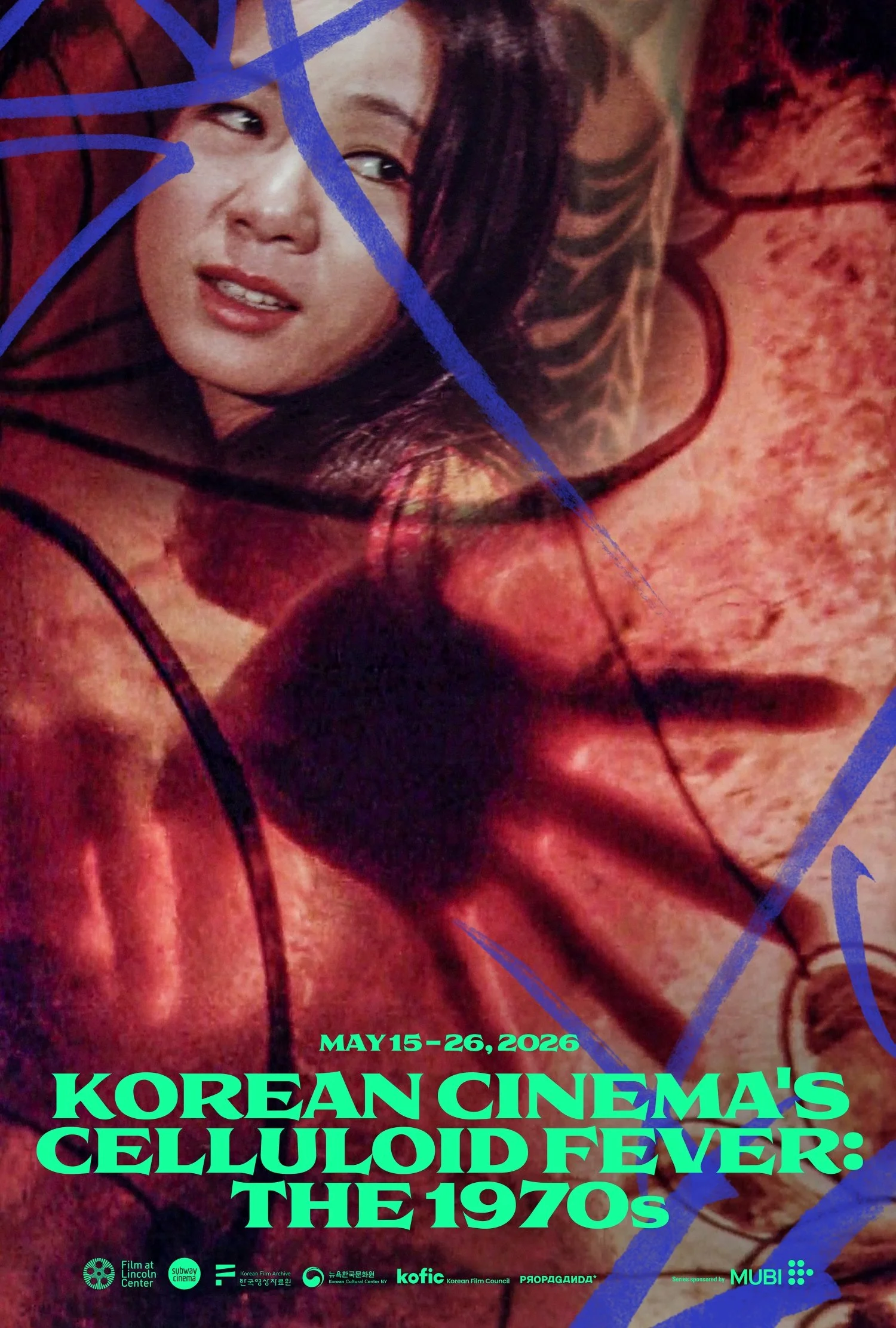
Film at Lincoln Center (FLC) and Subway Cinema present “Korean Cinema’s Celluloid Fever: The 1970s,” a wide‑ranging retrospective running from May 15 through 26, charting one of the most volatile and inventive eras in Korean film history. With 19 features and eight short films, the series includes newly restored classics, rare cult favorites, and landmark genre films, including many premieres of new digital remasters.
The 1970s appeared to be devastating for Korean cinema: television decimated theatrical attendance, while Park Chung-hee’s military government imposed a complex censorship system that rejected scripts and tore apart completed films. Yet within this repressive climate, a generation of filmmakers devised bold visual styles, smuggled sharp social critique into commercial genres, and quietly laid the groundwork for the global prominence Korean cinema enjoys today. The program spans this “dark decade,” from Kim Ki-young’s Woman of Fire (1970), starring Academy Award winner Youn Yuh-jung in her debut role, to Lee Doo-yong’s The Last Witness (1980), capturing a cinematic landscape shaped by repression, innovation, and transformation.
A central focus is “The Era of the Image,” Korea’s first film art movement, whose directors drew inspiration from European New Waves to depict a changing Korean society through stories of youth, urbanization, and social tension. Films such as Lee Jang-ho’s Heavenly Homecoming to Stars (1974), Kim Ho-sun’s Yeongja’s Heydays (1975), and Ha Gil-jong’s The March of Fools (1975) and The Pollen of Flowers (1972) reflect the aspirations and frustrations of a generation navigating rapid industrialization and cultural shifts.
During this period, leading directors were working at the height of their creative powers—from Kim Ki-young’s audacious, genre-blending works Ieodo (1977) and A Woman After a Killer Butterfly (1978) to Kim Soo-yong’s psychologically probing Night Journey (1977) and A Splendid Outing (1977). The program also spotlights visionary directors at the moment their brilliance begins to emerge—among them Im Kwon-taek with his quietly introspective masterworks Wangsimni, My Hometown (1976) and Genealogy (1978). Alongside these features, a shorts program showcases experimental filmmakers such as Han Okhi and Kaidu Club, Korea’s first feminist film collective, whose formally radical works reject narrative in favor of texture, repetition, and performance, transforming film itself into a medium of feminist resistance.
This era produced some wild genre experiments and international collaborations, notably action star Park No-sik’s absurdist comedy Why? (1972) and Jang Il-ho’s manga-inspired horror A Remodeled Beauty (1975), which screens in a world premiere new 4K remaster. The Korean Connection, part of the tae kwon do action cycle Lee Doo-yong made with Han Yong-cheol, reveals an industry looking outward even as the state tightened control at home. Paired with Kim Jee-woon’s Cobweb (2023)—a satirical portrait of a 1970s director battling censorship—these films show how directors reworked melodrama, horror, and political thrillers to probe power and survival in a decade of rapid, disorienting change.
The generation responsible for these films mentored the Korean New Wave directors of the 1980s and ’90s and paved the way for contemporary auteurs like Bong Joon Ho, Park Chan-wook, and Kim Jee-woon, underscoring that the “celluloid fever” of the 1970s never truly broke.
Following the May 16 screening of Lee Jang-ho’s seminal Heavenly Homecoming to Stars, audiences will be treated to a discussion about the Korean film industry and major trends and filmmakers in Korean cinema in the 1970s, a primer for the series as a whole. Two additional free screenings will be held at the Korean Cultural Center New York on May 21: Lee Man-hee’s Break the Chain (1971) and the 2008 Kim Jee-woon film that it heavily influenced, The Good, the Bad, the Weird.
“Korean Cinema’s Celluloid Fever: The 1970s” is sponsored by MUBI, the global streaming service, production company, and film distributor dedicated to elevating great cinema.
About Partners
◆ FILM AT LINCOLN CENTER
Film at Lincoln Center (FLC) is a nonprofit organization that celebrates cinema as an essential art form and fosters a vibrant home for film culture to thrive. FLC presents premier film festivals, retrospectives, new releases, and restorations year-round in state-of-the-art theaters at New York’s Lincoln Center for the Performing Arts. FLC offers audiences the opportunity to discover works from established and emerging directors from around the world with a passionate community of film lovers at marquee events including the New York Film Festival and New Directors/New Films.
Founded in 1969, FLC is committed to preserving the excitement of the theatrical experience for all audiences, advancing high-quality film journalism through the publication of Film Comment, cultivating the next generation of film industry professionals through our FLC Academies, and enriching the lives of all who engage with our programs.
◆ SUBWAY CINEMA
Subway Cinema is a nonprofit, volunteer-run organization dedicated to the exhibition and appreciation of Asian popular cinema. Founded in 1999, it has nurtured Asian film culture in the U.S. by championing directors including Johnnie To, Tsui Hark, Park Chan-wook, Bong Joon-ho, Takashi Miike, Kim Jee-woon, Ryoo Seung-wan, Seijun Suzuki, Sion Sono, and others. Subway Cinema founded and ran the New York Asian Film Festival (NYAFF)—North America’s premier popular Asian cinema festival—for 17 years. Its current focus is retrospective programming and preserving America’s Asian film exhibition heritage.
◆KOREAN FILM ARCHIVE
The Korean Film Archive (KOFA) is the national film archive of the Republic of Korea. Founded in 1974 as a non-profit organization, it operates under the Ministry of Culture, Sports and Tourism and has been a member of the International Federation of Film Archives (FIAF) since 1985. KOFA is dedicated to safeguarding Korea’s cinematic heritage by collecting, cataloguing, preserving, restoring, screening, and providing access to Korean cinema.
◆KOREAN FILM COUNCIL (KOFIC)
The Korean Film Council (KOFIC), a public institution under the Ministry of Culture, Sports and Tourism, is dedicated to enhancing the quality and global competitiveness of Korean cinema. By supporting creative production and fostering a sustainable industry ecosystem, KOFIC strives to lead the global market and inspire audiences worldwide.